Background
Radical resection of extensive or recurrent thymoma may require phrenic nerve resection which can be associated with significant respiratory morbidity. This study aims to demonstrate the feasibility of nerve reconstruction using a sural nerve graft by total robotic approach which has never been reported before.
Case Description
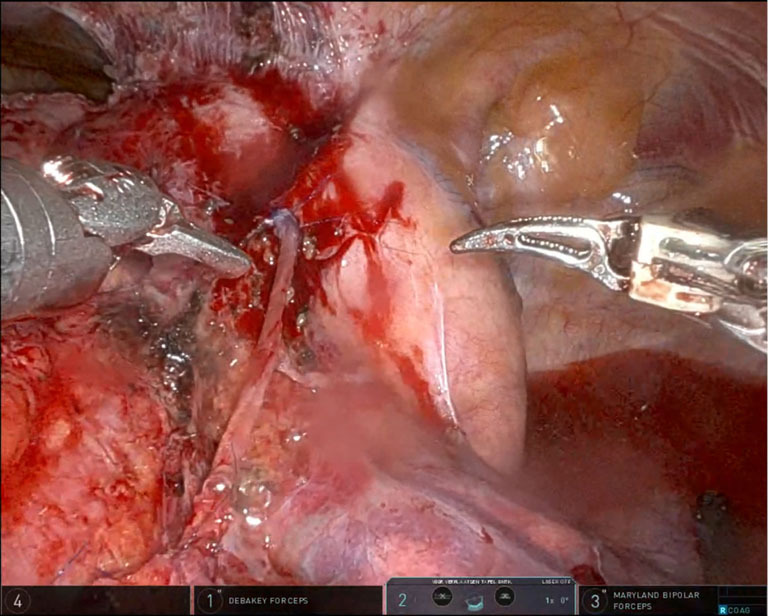
This case involved a 75-year-old male patient who underwent thymomectomy 5 years earlier in a different hospital. After 5 years, a local recurrence was evident exactly on the location of the left phrenic nerve at the level of the right ventricular outflow tract. Radical resection was deemed possible only if the phrenic nerve was excised together with the mass. To this end, we used our standardized three-port robotic-assisted thoracoscopic surgery (RATS) approach using the DaVinci Xi system (Intuitive surgical Inc., Sunnyvale, CA, USA) from the left mid-axillary intercostal plane and added a 12-mm assistant port. After careful introduction of the camera trocard, CO2 insufflation was started and the other trocards and instruments are introduced by sight. After dissection of the initially adhesive plain between the mediastinal pleura and the pericardium, the part of the pericardium overlaying the right ventricular outflow tract up to the level of the aortic arch was clear and the phrenic nerve was visible. The mass was located directly on the phrenic nerve and as expected no surgical plain with safe oncological margins could be achieved. There were no signs of growth into the pericardium or lung parenchyma. The phrenic nerve was transected caudally and cranially 3 cm from the mass and removed en-bloc with the recurrence within an endobag. The distal end of the sural nerve was anastomosed to the proximal end of the phrenic nerve due to the direction of development of the fascicles. A single 7-0 Prolene Suture (Ethicon Inc., New Jersey, US) was attached to this distal end before introduction in the thorax, to facilitate the first anastomosis and avoid the need for an additional instrument to present the graft. Each anastomosis was made by four single 7-0 Prolene epineural sutures using the Black Diamond micro forceps (Intuitive surgical Inc., Sunnyvale, CA, USA) (Figure 1).
Conclusions
The sural nerve is a preferred donor graft for reconstruction due to its well tolerated morbidity, ease of harvesting, multiple fascicles, and available length. Total robotic reconstruction is technically feasible and preferred in a minimal invasive approach. The postoperative course was uneventful and the patient was discharged after 3 days. Histopathological analysis revealed a B2 thymoma (World Health Organization).
https://pmc.ncbi.nlm.nih.gov/articles/PMC12529480
Jamie L R Romeo 1,✉, Jos G Maessen 1, Patrique Segers 1, Florit D Marcuse 2, Monique M H Hochstenbag 2, Hester A Gietema 3, Ulrich C Lalji 3, Myrurgia Abdul Hamid 4, Shan Shan Qiu 5